
For years, ERP systems were largely designed around the needs of the business as a whole. Everyone worked within the same system, navigated many of the same menus, and often had to find the information relevant to their role among a much larger set of data and functionality.
Modern ERP is moving in a different direction.
Instead of expecting every employee to interact with the system in the same way, ERP is becoming more tailored to the person using it. What a finance manager needs to see when they log in can be very different from what matters to someone managing inventory, overseeing operations, or running the company.
That shift toward a more personalized experience can make ERP easier to use while helping employees focus on the information and tasks that actually matter to their jobs.
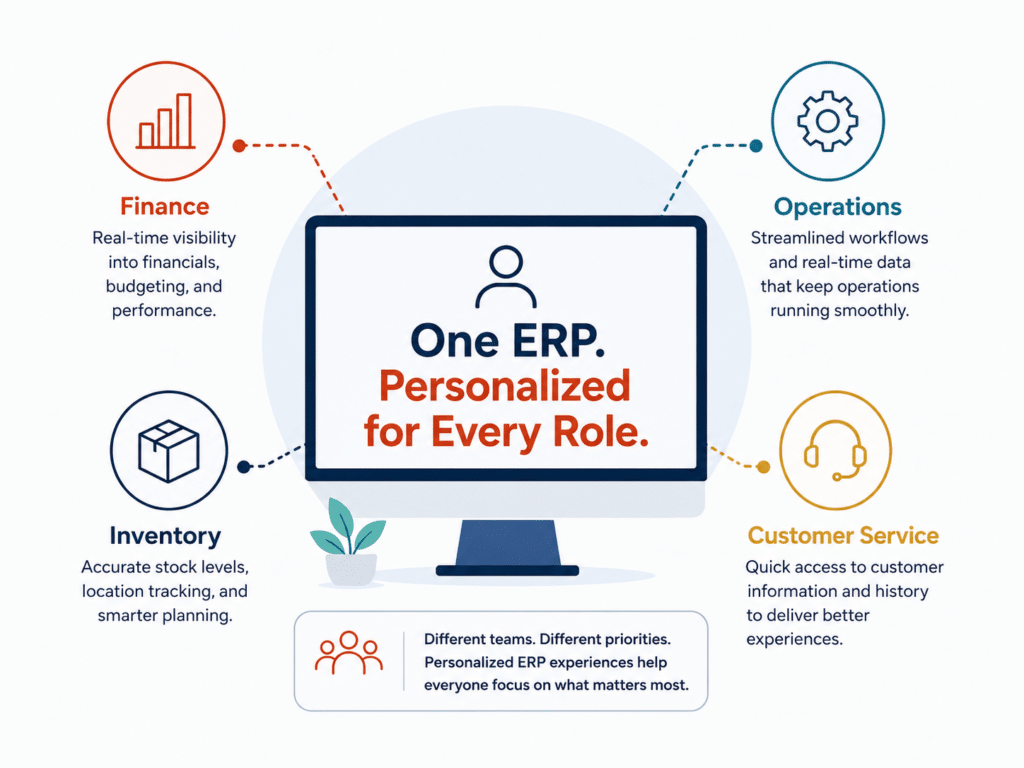
Think about how many different people might interact with an ERP system during a normal business day.
A finance team may be reviewing cash flow, invoices, expenses, and financial performance. Someone responsible for inventory may be watching stock levels and product availability. An operations manager might need to know whether orders are moving as expected, while an executive may want a quick understanding of overall business performance.
They are all working with information from the same business, but they aren’t necessarily asking the same questions.
When an ERP experience can reflect those differences, employees spend less time navigating information that has little to do with their responsibilities.
Personalization doesn’t mean creating a completely different system for every employee. It means making the same ERP more relevant to different users.
Role-based dashboards are one example. Instead of opening the system and searching for the information they need every morning, users can have important metrics, tasks, or exceptions presented in a way that is more relevant to their responsibilities.
Navigation can also reflect how someone actually works. Frequently used screens and functions can be easier to reach, while information that isn’t part of someone’s normal responsibilities doesn’t have to dominate their experience.
The result is an ERP environment that can feel much less like a large database employees have to navigate and more like a workspace built around what they need to accomplish.
The idea of personalization is also changing as intelligence becomes more deeply embedded in modern ERP platforms.
Traditionally, personalization might have meant choosing which information appeared on a dashboard or adjusting how a screen was arranged. Those capabilities are still valuable, but newer ERP technology is beginning to go further.
Intelligent tools can increasingly help surface information that deserves attention, assist with routine work, answer questions about business information, and identify unusual activity that a user may want to investigate.
That creates the potential for an ERP experience that isn’t simply organized around a person’s role, but is also more responsive to what is happening in the business.
For example, the most useful information on a manager’s screen may not always be the same five metrics. Sometimes the most valuable information is the unexpected order, unusual change, or exception that needs attention today.
An ERP system can offer extensive functionality, but that doesn’t automatically mean employees will find it easy to use.
When users regularly have to search through information that isn’t relevant to them, memorize where certain functions are located, or rely on workarounds to complete routine tasks, the system can create unnecessary friction.
A more role-focused experience can reduce some of that friction.
It can also make training more relevant. Instead of teaching every employee everything the ERP can do, training can focus more closely on the processes, information, and tools that person will actually use.
For businesses evaluating ERP, this makes usability an important part of the conversation. A demonstration shouldn’t only show what the software can do. It should also show what using it will look like for the different people who will depend on it.
During an ERP evaluation, it can be helpful to move beyond the standard product demonstration.
Ask what the experience looks like for the people in your organization.
What does a finance user see? How would someone responsible for inventory work within the system? What information would a manager have available when they start the day? Can different users quickly access the tasks and information most relevant to them?
These questions can reveal something a long feature checklist often cannot: what it may actually feel like for your team to use the system every day.
People don’t experience a business from the same perspective simply because they work for the same company.
Their responsibilities are different. The decisions they make are different. The information they need is different.
Modern ERP is increasingly reflecting that reality.
As ERP platforms become more user-friendly and intelligent, personalization is becoming an important part of how businesses can make sophisticated technology more practical for the people using it.
For companies considering a new ERP, the question is no longer only whether the system can support the business. It’s also worth asking how well it can support the individual people who keep that business running.
Want to see what a modern ERP experience could look like for your team? ACC Software Solutions can help you explore your options and discuss what matters most for your business. Schedule a complimentary conversation with our team.
Contact ACC Software Solutions | Explore Our ERP Services
Solutions by Industry
What's New
What Should Be Part of Your 2027 Technology Plan?
Read MoreSubmitted by Courtney Quinn on Fri, 09/25/26 - 10:39
What Today’s Distributors Are Being Asked to Manage
Read MoreSubmitted by Courtney Quinn on Thu, 09/17/26 - 13:38

Your Business Has Changed. Have Your Processes?
Read MoreSubmitted by Courtney Quinn on Fri, 09/11/26 - 11:29
Whatever Your ERP Needs, We Have the Solution!
Or call us for a free consultation 866-379-3799