
QuickBooks may have been the right starting point for your business, but as operations become more complex, Acumatica offers capabilities that go beyond traditional accounting software.
QuickBooks is a familiar name for business owners, and many companies have relied on it for years to manage their finances. It handles essential accounting tasks, from invoicing and expenses to financial reporting.
But managing a business involves much more than keeping accurate financial records.
As companies expand, they often need better ways to coordinate inventory, manage purchasing, track orders, and connect information across departments. That’s where the differences between accounting software and a comprehensive ERP system become important.
For businesses considering their next step, Acumatica offers a different approach to managing financial and operational processes.
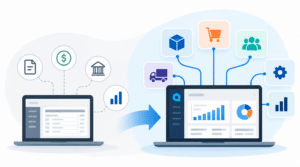
QuickBooks is primarily designed for financial management. While certain versions offer inventory capabilities, automation, and integrations, businesses with more complex operations may find themselves relying on additional applications to manage their work.
Acumatica brings financial management and business operations together within a connected cloud ERP platform.
For example, when a customer places an order, the information can connect to inventory availability, purchasing requirements, fulfillment, and financial records.
Instead of treating these activities as separate processes, Acumatica helps businesses manage how they work together.
This can be especially valuable for companies where accounting is closely tied to inventory, production, or customer orders.
Inventory management becomes increasingly important as businesses add products, locations, or more complicated purchasing requirements.
While QuickBooks offers inventory tracking in certain plans, Acumatica provides more extensive inventory management capabilities designed for businesses with complex operations.
With Acumatica Distribution Edition, companies can manage:
For distributors and manufacturers, having these processes connected to financial information can help improve coordination between departments.
It also gives employees a clearer understanding of what’s available, what’s committed to customers, and what needs attention.
Financial reports are essential, but they don’t always provide the complete picture of what’s happening throughout a business.
A company may understand its revenue and expenses while still needing additional information about inventory performance, purchasing activity, or order fulfillment.
Acumatica connects financial data with operational information, allowing businesses to build reports and dashboards around the activities that matter to them.
A business owner might want to understand which products are performing well, while a purchasing manager needs to review inventory availability and upcoming requirements.
With connected information, both can work from the same underlying business system.
This helps reduce the effort involved in gathering information from multiple sources and gives decision-makers a more complete understanding of business performance.
Not every business manages its operations the same way.
A wholesale distributor has different requirements than a manufacturer. A construction company needs capabilities that may not be relevant to a professional services organization.
Acumatica offers industry-specific ERP editions designed around these differences.
For example:
Distribution: Manage inventory, purchasing, warehouse operations, and customer orders through Acumatica Distribution Edition.
Manufacturing: Connect production planning, materials management, and manufacturing operations with financial information.
Construction: Manage project costs, commitments, and financial activities within a connected system.
Rather than building every operational process around accounting software, businesses can select an ERP solution designed to support their industry’s requirements.

One of the most important considerations when evaluating business software is how well it can support future needs.
A company operating from one location may eventually expand to multiple warehouses. A business with a relatively simple product catalog may introduce new product lines or more complex order requirements.
These changes often create additional demands on the systems employees use every day.
Acumatica provides a flexible cloud ERP platform that businesses can configure and expand as their requirements evolve.
Its connected applications and integration capabilities can help organizations introduce new processes without relying on a collection of disconnected tools.
The result is a system designed to support both current operations and future business plans.
Moving from QuickBooks to Acumatica is a significant decision, and it should start with understanding what your business actually needs.
The question isn’t whether QuickBooks can still handle your accounting. It’s whether your current software environment can support everything happening around it.
If inventory management, order processing, purchasing, or other operational activities are becoming increasingly complex, it may be worth exploring what a comprehensive ERP system can offer.
Acumatica provides an opportunity to connect those processes and create a more unified approach to managing your business.
At ACC Software Solutions, we help businesses evaluate their current systems and understand how Acumatica can support their financial and operational needs.
As an Acumatica Gold Partner with more than 30 years of experience, our team provides ERP consulting, implementation, training, and ongoing support.
If you’re currently using QuickBooks and wondering what your business could accomplish with a more comprehensive system, we’d be happy to help you explore your options.
Ready to see what Acumatica could do for your business?
Schedule a free consultation with ACC Software Solutions.
Contact ACC Software Solutions | Explore Our ERP Services
Solutions by Industry
What's New
Still Using QuickBooks? Here’s What Acumatica Can Do Differently
Read MoreSubmitted by Courtney Quinn on Mon, 10/19/26 - 13:27
Where Does Your Team Lose Time Without Realizing It?
Read MoreSubmitted by Courtney Quinn on Fri, 10/09/26 - 11:33
What Should Be Part of Your 2027 Technology Plan?
Read MoreSubmitted by Courtney Quinn on Fri, 09/25/26 - 10:39
Whatever Your ERP Needs, We Have the Solution!
Or call us for a free consultation 866-379-3799