
Growth is usually the goal.
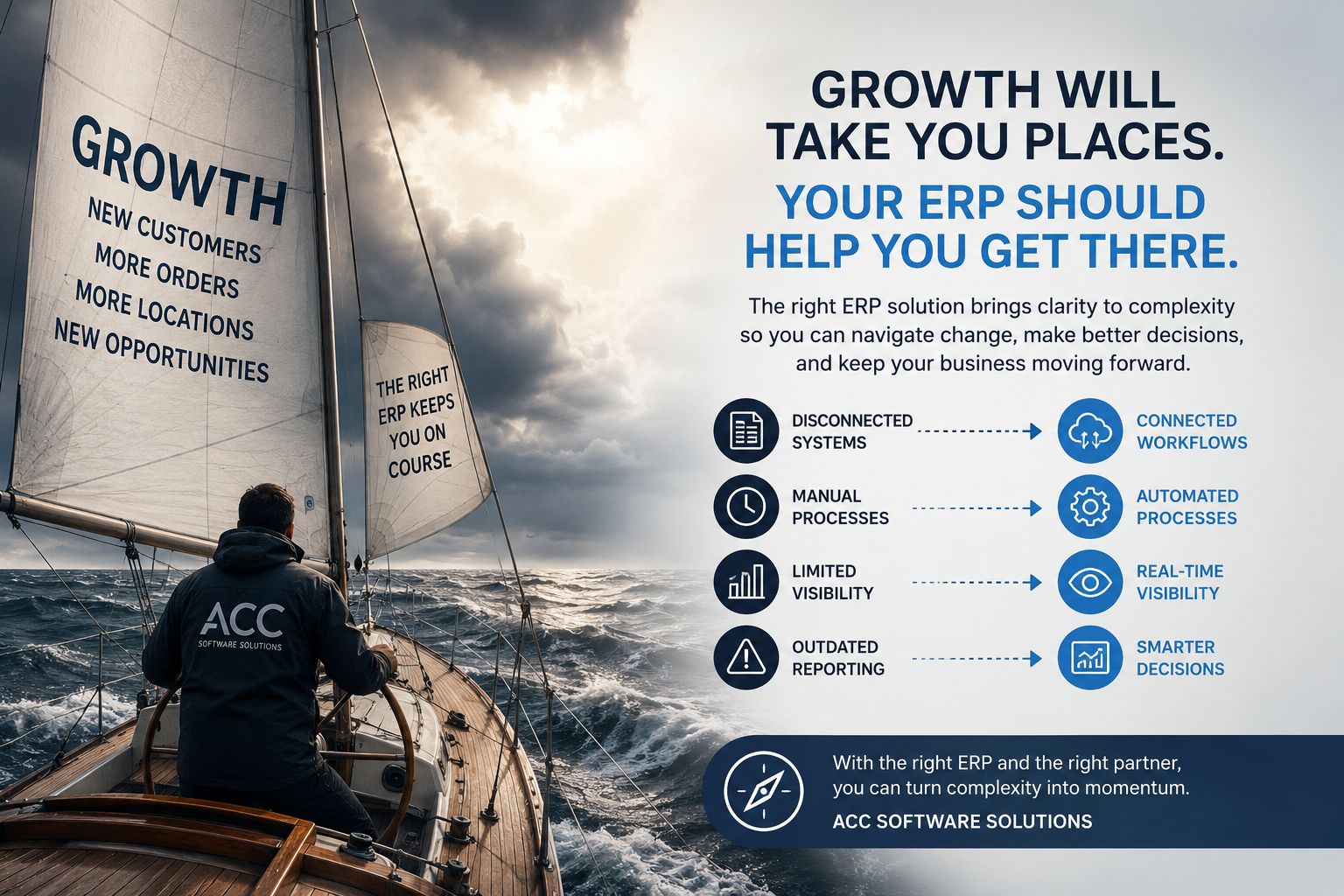
More customers, more orders, more locations, more employees, more opportunities.
But as businesses grow, operations often become harder to manage. Processes that once worked fine suddenly create delays, duplicate work, reporting issues, and visibility gaps across departments.
The challenge is not growth itself. The challenge is trying to scale with systems and processes that were built for a smaller business.
That’s why ERP conversations are changing across the industry. Recent updates from both Acumatica and Sage show a growing focus on automation, AI-driven workflows, real-time reporting, and operational visibility, because modern businesses need systems that can keep pace with expansion.
Most growing companies don’t notice operational strain immediately.
It usually starts small:
At first, these workarounds seem manageable.
But as transaction volume increases, small inefficiencies multiply quickly.
A purchasing process that takes a few extra minutes per order becomes a serious operational issue when order volume doubles. A finance team that manually reconciles reports each month eventually spends more time fixing data than analyzing it.
Growth exposes inefficiencies that smaller businesses can often work around temporarily.
ERP systems used to focus primarily on recording transactions.
Today, businesses expect ERP platforms to provide operational visibility, automation, forecasting insight, and connected workflows across departments.
At recent product events and release announcements, Acumatica highlighted expanded AI capabilities, workflow automation, and industry-specific functionality designed to help businesses improve decision-making and reduce manual processes.
Meanwhile, Sage continues investing heavily in AI-powered finance tools, cloud-connected operations, and intelligent automation designed to improve efficiency for growing businesses.
The direction is clear across the ERP industry:
Businesses want faster access to information, fewer manual processes, and systems that can adapt as operations become more complex.
As organizations grow, operational strain often appears in a few key areas:
These issues are not unusual. They are often signs that operational complexity has outgrown the systems supporting it.
Modern ERP systems are no longer just accounting platforms.
Cloud ERP allows businesses to connect departments, automate workflows, improve reporting visibility, and support expansion without relying on disconnected systems or manual processes.
Recent updates from Acumatica continue emphasizing distribution, manufacturing, retail, construction, and professional services functionality alongside automation and AI-driven operational improvements.
Across the ERP market, businesses are moving toward platforms that provide:
The goal is not simply replacing software.
The goal is building an operational environment that can support continued growth without adding unnecessary complexity.
The businesses scaling most effectively today are not necessarily adding more manual processes as they grow.
They are simplifying operations, improving visibility, and creating more connected workflows across departments.
ERP should help businesses operate more efficiently as they expand, not create additional friction.
At ACC Software Solutions, we work with growing organizations to evaluate operational challenges, improve visibility across departments, and implement ERP solutions that support long-term scalability with platforms like Acumatica and Sage.
Contact ACC Software Solutions | Explore Our ERP Services
Solutions by Industry
What's New

Where Does Your Team Lose Time Without Realizing It?
Read MoreSubmitted by Courtney Quinn on Fri, 10/09/26 - 11:33
What Should Be Part of Your 2027 Technology Plan?
Read MoreSubmitted by Courtney Quinn on Fri, 09/25/26 - 10:39
What Today’s Distributors Are Being Asked to Manage
Read MoreSubmitted by Courtney Quinn on Thu, 09/17/26 - 13:38
Whatever Your ERP Needs, We Have the Solution!
Or call us for a free consultation 866-379-3799